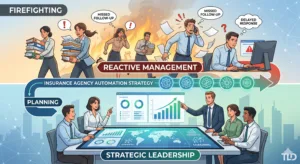
From Firefighting to Planning: Insurance Agency Automation Strategy
How Automation Helps Leaders Focus on Strategy
In many insurance agencies, leadership time is consumed by immediate issues. Missed follow-ups, delayed responses, uneven agent performance, and reporting gaps create a constant need for intervention. Leaders spend their days reacting, solving problems as they appear rather than guiding long-term growth.
This reactive cycle, often referred to as “firefighting,” limits an agency’s ability to scale. When leaders are focused on daily disruptions, strategic planning takes a back seat.
An effective insurance agency automation strategy provides a path out of this cycle. By structuring workflows and reducing manual oversight, it allows leaders to shift from reactive management to proactive strategy.
Why Agencies Get Stuck in Firefighting Mode
Firefighting is rarely intentional. It develops when systems lack consistency and visibility.
Common causes include:
- Leads not being routed or worked consistently
- Follow-ups being missed or delayed
- Limited real-time visibility into agent activity
- Reporting that requires manual compilation
When these issues occur, leaders step in to fix them. Over time, this becomes the default mode of operation.
Instead of focusing on growth, leaders are pulled into daily execution.
The Hidden Cost of Reactive Leadership
Reactive leadership affects more than time management. It impacts performance across the entire agency.
When leaders are constantly solving problems:
- Strategic initiatives are delayed
- Coaching becomes inconsistent
- Performance trends go unnoticed
- Growth opportunities are missing
A structured insurance agency automation strategy reduces these disruptions and allows leaders to operate with greater clarity.
Automation Creates Operational Stability
Automation reduces the number of issues that require immediate attention. By standardizing processes, it ensures that routine tasks are handled consistently.
Key areas where insurance workflow automation improves stability include:
- Lead route and assignment
- Follow-up scheduling and reminders
- Activity tracking and documentation
- Reporting and performance monitoring
When these processes run automatically, fewer problems arise, and leaders spend less time intervening.
From Monitoring to Visibility
One of the biggest shifts automation creates is the move from monitoring to visibility.
In reactive environments, leaders must constantly check activity to ensure tasks are being completed. This creates a cycle of oversight that consumes time and energy.
With a strong insurance agency automation strategy, activity is tracked in real time. Leaders can see what is happening without needing to manage each step directly.
Platforms like TLD provide dashboards and reporting that surface key metrics, allowing leaders to focus on trends rather than individual tasks.
Freeing Up Time for Strategic Thinking
As operational noise decreases, leaders gain time to focus on higher-level priorities.
This includes:
- Evaluating lead sources and marketing performance n- Refining sales processes and call strategies
- Developing agents through structured coaching
- Planning for growth and expansion
Automation does not eliminate leadership responsibility. It reallocates it to areas that drive long-term success.
Supporting Consistent Team Performance
When workflows are automated, expectations become clearer across the team.
Agents follow structured processes for handling leads, completing follow-ups, and logging activity. This consistency reduces variability and improves overall performance.
Leaders no longer need to address the same issues repeatedly. Instead, they can focus on coaching and improvement.
TLD as a Foundation for Strategic Leadership
TLD integrates automation into daily agency operations as part of a complete insurance agency automation strategy. Lead routing, follow-up workflows, activity tracking, and reporting all functions within one connected system.
Because these processes are automated and aligned, leaders gain reliable visibility into performance without constant intervention.
TLD dashboards highlight activity, trends, and exceptions, allowing leaders to quickly identify where attention is needed and where performance is strong.
This structure supports a shift from reactive problem-solving to proactive decision-making.
Building a Strategy-Driven Agency
Moving from firefighting to planning does not happen overnight. It requires systems that reduce operational friction and create consistency.
An insurance agency automation strategy provides the foundation for this transition. By handling routine tasks and ensuring that processes are followed, it allows leaders to step back from daily disruptions.
With the right systems in place, leaders can focus on guiding the agency, improving performance, and planning for growth.
Leading with Clarity Instead of Urgency
The most effective leaders are not the ones who respond fastest to problems. They are the ones who build systems that prevent those problems from occurring.
Automation enables this shift. It replaces urgency with clarity and reaction with strategy.
With platforms like TLD, insurance leaders can move beyond firefighting and create an environment where planning, growth, and performance improvement become the primary focus.
Discover how TLD helps agency leaders implement an effective insurance agency automation strategy and focus on what drives long-term success.